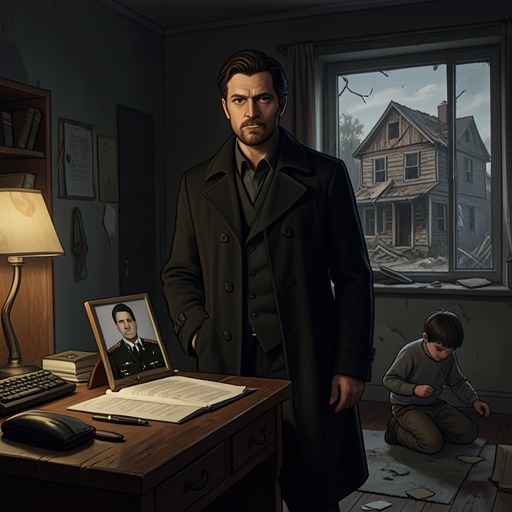
Dan Robie's pretrial detention for Sherman Clancy's murder
The GuiltyDan Robie’s pretrial detention for Sherman Clancy’s murder turns an accusation against a former judge and lawyer into an immediate legal and family crisis. Arrested on evidence that pointed to Clancy’s killing, Dan is arraigned, pleads not guilty, and chooses to represent himself; the prosecution asks that he remain jailed, arguing that threats make detention safer. For Will Robie, the charge also sharpens an uneasy distinction between his father’s capacity for violence and the meaning of murder.
Arrest and Arraignment
Blue Man tells Will that his father has been arrested, then adds that the charge is murder. The case file offers only sketchy facts: Sherman Clancy is dead, he knew Dan, and evidence points to Dan as the killer. The arrest places Dan in a jail cell in Cantrell, Mississippi, a small town near the Louisiana border and less than five miles from the Gulf Coast.
The charge lands with particular force because Will does not regard his father as incapable of killing. Dan is tough, can be violent, and killed during the Vietnam War. But Will distinguishes killing from murder, just as he separates his own completed missions—which technically involved killing—from the identity of a murderer. That uncertainty gives the detention more than a procedural meaning: while the case is still poorly defined, Will must weigh the evidence against his knowledge of his father and the moral categories through which he understands violence.
At the arraignment, Sheila Taggert calls the case as the State of Mississippi’s first-degree murder charge against Daniel Robie for the willful killing of Sherman Clancy. Judge Benson advises Dan to seek independent legal counsel, noting that appointed counsel would be available if he could not afford a lawyer. Dan declines to change course. Asked for his plea, he answers not guilty immediately, while standing by his decision to act as his own lawyer.
Aubrey Davis, speaking for the prosecution, asks the court to set no bail and remand Dan to the Cantrell jail until trial. The request is not ultimately presented as a claim that Dan is likely to flee. Davis explains that the state has received threats against Dan’s life and argues that remaining in jail would be safer for him. Judge Benson takes the arguments under consideration and, pending her decision, orders Dan remanded to the custody of the State of Mississippi. His detention is therefore provisional in its stated rationale, but immediate in effect: he is removed from the courtroom before the question of bail has been resolved.
The Investigation Reopens the Meaning of the Charge
Dan’s detention unfolds while the apparent boundaries of the Clancy case begin to break down. Jessica Reel reveals that her assignment is with ViCAP, the Violent Criminal Apprehension Program, and confirms that the Federal Bureau of Investigation is investigating a possible serial killer. The inquiry links Sherman Clancy and Janet Chisum to eight other killings in four states over nine years. In those cases, an older man paid a younger woman for sex; the man was later found with his throat slit in his car, while the woman had been shot in the head and left in a body of water. The pattern does not establish who killed Clancy, but it makes the accusation against Dan part of a wider inquiry rather than an isolated local case.
The pattern also contains differences that complicate any easy conclusion. The killings were generally spaced about eighteen months apart, while the Arkansas murders had occurred four years earlier; Jessica Reel wonders whether that longer interval matters. She also asks whether the earlier cases involved a long gap between the woman’s death and the older man’s, and learns that none had a gap as long as the one in Cantrell. Will acknowledges that his father had a motive to kill Sherman Clancy, but points out that this does not explain Janet Chisum’s murder. The distinction leaves Dan’s possible motive in one killing separate from the question of whether the two Cantrell deaths belong to the same series.
Later, when Will asks Victoria whether she killed the other people under investigation by the Federal Bureau of Investigation, she claims responsibility for those killings and describes the interval before the Cantrell murders as the time when she met Dan, married him, became pregnant, and had Tyler. Her admission radically changes the significance of the cross-state pattern, but the exchange does not itself settle Dan’s responsibility for Clancy’s death. His pretrial detention thus remains suspended between an accusation founded on evidence pointing toward him and an investigation whose eventual revelations expose a different perpetrator behind the linked killings.
Confession and the Unresolved Charge
When Will asks Victoria whether she killed the other people the Federal Bureau of Investigation is investigating, she acknowledges the killings and presents repetition as practice. She casts her victims as people she considered deserving of removal: older men who sought sex and younger women she judged stupid and greedy. The account exposes not only her responsibility for the linked murders but the moral excuse she uses to make them seem justified. Will rejects that excuse, naming the acts as murder rather than allowing them to be softened by her explanation. Her admission changes the meaning of the broader investigation that had placed Dan’s case beside a series of killings, but it does not, by itself, resolve the separate accusation that he killed Sherman Clancy. The distinction leaves the legal question at the heart of Dan’s detention open even as the serial pattern acquires a confessed perpetrator.
Family Witnesses at the Detention Order
As Dan Robie is remanded, the courtroom briefly makes the legal order a family scene. His gaze passes across the room and pauses when it reaches Will Robie, but only for an instant before he turns away. Dan is being led out at the moment Victoria appears through the main door, dressed entirely in black, her skirt at the knee and her high heels matching her clothes. The sequence offers no explanation of either gesture, yet places the son’s brief acknowledgment and Victoria’s entrance alongside the immediate consequence of the court’s order: Dan leaves the courtroom in custody while those closest to him remain behind.